
What is a fireproof sandwich panel?
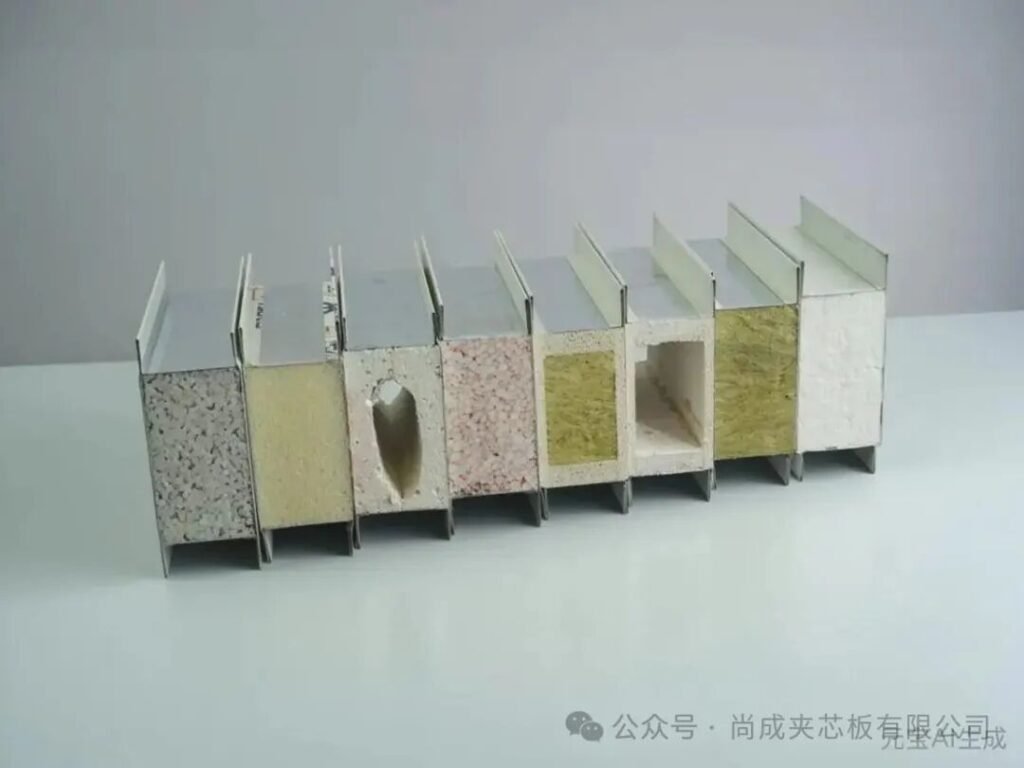
Fire-resistant sandwich panels are composite panels made by bonding or laminating two layers of metal panels (or other fire-resistant surface materials) with a middle composite flame-retardant core material (such as rock wool, glass wool, aluminum silicate, etc.). They are primarily used in building envelopes such as walls and roofs, achieving fire separation and fire-resistant protection through the flame-retardant properties of the core material and structural design.
In short, they solve the problems of heat transfer control, evacuation time, and property damage reduction in building fire scenarios.
In layman’s terms: you can think of it as a building’s “fireproof armor.” If we compare a building’s structure to the skeleton of the human body, then the fireproof sandwich panel is like the “fireproof armor” covering the skeleton—the outer metal panel provides structural support, like the hard outer shell of armor, resisting external impacts; while the flame-retardant core material in the middle is like the fireproof cotton lining the armor, which, in the event of a fire, slows down heat transfer through its non-combustible or flame-retardant properties, buying precious protection time for the “life safety zone” inside the building.
What are the fire resistance ratings of fire-resistant sandwich panels? Core features and principles.
The fire resistance performance of fire-resistant sandwich panels is their core indicator, and the classification of fire resistance ratings directly determines their applicability in different building scenarios.
According to the national standards “Classification of Burning Performance of Building Materials and Products” (GB 8624) and “Code for Fire Protection Design of Buildings” (GB 50016), common fire resistance ratings can be divided into the following categories, each with different core characteristics and applicable scenarios:
- A1 grade: Non-combustible materials, zero risk of combustion.
A1-grade fire-resistant sandwich panels have a core material made of non-combustible materials (such as rock wool or glass wool). Under specified test conditions, they will not burn and will not produce open flames or continuously burning molten drips.
Their core characteristic is “zero flammability,” making them suitable for scenarios with extremely high fire protection requirements, such as firewalls and fire-resistant partitions in high-rise buildings, hospitals, schools, subways, and other densely populated areas.
- Grade A2: Non-combustible materials, low smoke production restrictions.
Grade A2 is also a non-combustible material, but it differs from Grade A1 in its smoke production characteristics—in combustion tests, its smoke toxicity and smoke density must meet lower limits. This type of material is commonly used in locations requiring both fire resistance and smoke control, such as equipment shafts and machine room enclosures in commercial complexes.
- Class B1: Flame-retardant material, delaying the spread of combustion
B1-grade fire-resistant sandwich panels have a core material made of flame-retardant materials (such as flame-retardant polystyrene or flame-retardant polyurethane). While they will burn under open flame, they self-extinguish rapidly after the fire source is removed, and the spread of fire is slow. Their core characteristic is “self-extinguishing,” making them suitable for non-load-bearing walls or roofs in ordinary industrial plants and warehouses. They must be used in conjunction with other fire prevention measures.
- Class B2: Combustible materials, with limited fire protection aids.
B2 grade core material is a combustible material (such as ordinary polystyrene). It achieves a certain flame-retardant effect by adding only a small amount of flame retardant. It burns quickly in a fire and is only suitable for temporary buildings or non-load-bearing enclosures with very low fire protection requirements. It should be selected with caution.
Typical Applications and Industry Representatives
In practical engineering, the selection of fire-resistant sandwich panels requires a comprehensive judgment based on building type, fire resistance rating requirements (such as 1 hour, 2 hours, 3 hours), and usage scenario. The following are key dimensions to consider in procurement decisions:
- Determine Fire Resistance Rating and Limit Requirements
First, determine the required fire resistance rating (e.g., A1 rating for firewalls in high-rise buildings) and fire resistance limit (i.e., the time it takes for the material to maintain its integrity and insulation properties during a fire) according to building design codes. For example, fire-resistant partitions in hospital operating rooms typically require a fire resistance limit of ≥3 hours, in which case A1-grade materials with high core density and a reasonable structural design should be selected.
- Verify authoritative testing reports
Fire resistance performance must be verified by a report issued by a third-party testing agency. When selecting fire-resistant sandwich panels, in addition to specifying the fire resistance rating, it is also necessary to pay attention to whether the product has complete testing data. For example, Shangcheng, as a brand with a certain level of recognition in the industry, provides A1-level non-combustible reports and test data showing a fire resistance limit of up to 3 hours for some of its fire-resistant sandwich panel products, aiming to help users meet high-level fire protection design requirements.
- Balancing performance and cost: How much does fireproof board cost per square meter?
The price of fireproof boards per square meter, a common concern for users, needs to be determined by multiple factors: core material type (non-combustible core materials such as rock wool, magnesium oxide, magnesium oxysulfate, and non-combustible foam have higher costs than flame-retardant polystyrene), panel thickness (the price difference between 0.3mm and 0.8mm metal panels is significant), fire resistance rating, and purchase quantity. It is important to note that price is not the only criterion; a low price may correspond to lower fire resistance performance, and meeting design specifications should be the priority.
Common misconception: What is it not?
Myth 1: “Fireproof sandwich panels = never burn”
The core of the “fire resistance” of fire-resistant sandwich panels lies in their “fire resistance limit,” which is the time required to slow the spread of fire and the transfer of heat, rather than being completely non-combustible. Even A1-grade panels may lose their protective function due to structural damage under extreme high temperatures and must be used in conjunction with the overall building fire protection design (such as sprinkler systems).
Myth 2: “The thicker the core material, the higher the fire resistance rating.”
The fire resistance rating is determined by the combustion performance of the core material (A1/A2/B1/B2), not by its thickness. For example, a 50mm thick A1 grade rock wool board still has a higher fire resistance rating than a 100mm thick B1 grade polystyrene board. Thickness only affects the duration of the fire resistance limit (for the same rating, thicker core materials usually have a longer fire resistance limit).
Myth 3: “High price = good performance”
Prices are influenced by multiple factors, including core materials, panels, and manufacturing processes. Some brands may inflate prices due to brand premium or non-essential features. When choosing a product, focus on core indicators such as fire resistance rating, core material density, and bonding strength, rather than blindly pursuing the highest price.
Only by clearly defining fire resistance ratings, selecting appropriate options based on specific scenario requirements, and verifying authoritative reports can fire-resistant sandwich panels truly become a “reliable barrier” for building safety. For procurement decision-makers, rationally balancing performance, cost, and regulatory requirements is crucial to ensuring the fire safety of projects.