
In today’s increasingly competitive food processing industry, many pre-prepared food factories face the challenge of upgrading their old workshops due to substandard cleanliness levels, despite the inability to halt production.
This article provides a phased construction solution that utilizes the scientific application of core materials such as magnesium oxide boards and magnesium oxysulfate boards to upgrade cleanrooms without interrupting production, helping companies complete environmental improvements while maintaining operations.
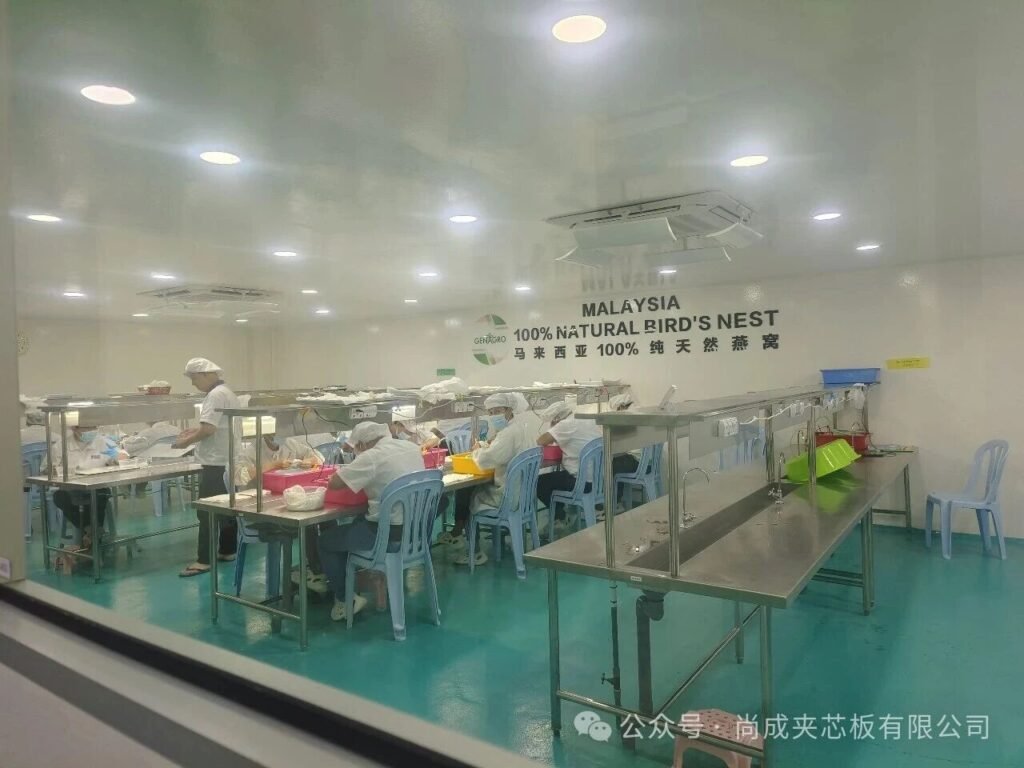
Step 1: Comprehensive Assessment and Phased Planning
Before renovation, a comprehensive assessment of the existing brickwork workshop is required, including structural safety testing (assessment of wall and floor load-bearing capacity, cracks, or settlement) and analysis of the existing production process.
Based on this, a phased construction plan is developed according to the production rhythm of the prefabricated food factory. The workshop is divided into multiple areas, and renovations are carried out sequentially, ensuring complete isolation between production and construction areas.
Rational planning of personnel and material flow channels to avoid cross-contamination is crucial for maintaining uninterrupted production.
Step 2: Modular installation of the building envelope
This stage is crucial for pollution control. After demolishing the old walls, a new enclosure structure is quickly established using a modular installation method.
Magnesium oxide board or magnesium oxysulfate board is ideally suited for use as wall and ceiling panels in cleanrooms due to its dustproof, fireproof, and antistatic properties.
- Modular Construction Advantages: Choosing modular panels like Shangcheng sandwich panels allows for factory prefabrication and rapid on-site assembly and installation. This significantly shortens the construction period, reduces dust and solid waste generated during on-site processing, and facilitates future adjustments to the workshop layout.
- Installation Points: Installation should follow the principle of “erecting panels first, then adding top panels.” Joints between panels must be tight, gaps must be sealed with two-component sealant, and all corners should be rounded to prevent dust accumulation and bacterial growth.
Step 3: Cleanroom System Integration and Debugging
After the building envelope is constructed, an independent air purification system must be deployed. This system should include multi-stage filtration (pre-filter, medium-efficiency filter, high-efficiency particulate air, and HEPA filter) and be equipped with a temperature and humidity control unit.
For pre-prepared food processing plants, it is also crucial to control the relative humidity of the workshop to prevent product spoilage or excessive dryness. Air showers and pass-through windows should be installed at the workshop entrance to purify personnel and materials.
After system installation, at least 72 hours of continuous operation testing must be conducted to verify that cleanliness, temperature, humidity, and other indicators meet design standards (such as ISO cleanliness levels).
Step 4: Final Validation and Production Recovery
After each area is completed, a thorough cleaning and disinfection are performed. Then, the cleanliness of the area is tested using equipment such as a particle counter. Once the standards are met, production equipment can be moved in and production activities resume in that area. The next area can then be modified according to the plan.
After all modifications are completed, a comprehensive assessment of the entire workshop’s operation should be conducted, and corresponding maintenance procedures should be established, including regular filter replacement to ensure the continuous stability of the clean environment.
Precautions
- Safety First: During the renovation and construction period, production areas and construction areas must be strictly separated, and safety isolation and protection measures must be implemented to ensure the safety of personnel and equipment.
- Material Selection: Choosing high-quality cleanroom panels is crucial. Key considerations should include the fire resistance rating of the panels (preferably A1), the environmental friendliness and stability of the core material (such as the moisture-proof and water-resistant properties of magnesium oxysulfate boards), and the flatness and strength of the panel surface. Choose reputable suppliers to avoid substandard cleanliness or repeated repairs due to panel quality issues.
- About Shangcheng Sandwich Panels: For prefabricated vegetable factories seeking efficient and environmentally friendly renovations, the modular customization of Shangcheng sandwich panels offers significant advantages. The panels can be produced according to engineering design requirements, enabling modular installation. This helps to significantly reduce foundation engineering and structural costs, allows for multiple disassembly and reassembly, facilitates construction, effectively controls on-site solid waste, and thus reduces overall costs.
- Through the above steps, prefabricated vegetable factories can gradually upgrade traditional brick-walled workshops into clean spaces that meet modern food safety production requirements without affecting normal production.